BIM Clash Detection Services UK
BIM Clash Detection & Coordination Services for UK Projects
We review federated architectural, structural and MEP BIM models to identify geometric conflicts, clearance issues and multidisciplinary coordination risks before they reach site.
Clash testing can be configured around agreed model packages, tolerances, project zones and coordination priorities, with issues reported for review by the responsible design and construction teams.
Discuss Your Coordination Scope
Send us your discipline models, BIM requirements and coordination priorities and we can review the required clash-detection workflow.
What Is BIM Clash Detection?
Finding Model Conflicts Before They Become Site Problems
BIM clash detection is the structured review of digital building models to identify physical conflicts and spatial coordination issues between different systems. Architectural, structural and MEP models can be combined into a federated environment so that project teams can review interfaces such as ducts through beams, pipework crossing structure, insufficient access clearances or overlapping services before construction information is finalised.
Federated Model Review
Architectural, structural and MEP model information brought together for multidisciplinary review.
Defined Clash Rules
Tests configured around relevant model groups, tolerances and coordination priorities.
Traceable Issues
Coordination problems documented so responsible teams can review and respond.
Iterative Review
Updated models can be retested to check whether reported issues remain, change or are resolved.
Clash Types
Different Coordination Problems Require Different Tests
Clash testing should be configured around the model content and project coordination requirements rather than running every discipline against every other element without context.
01 / Hard Clash
Physical Intersections
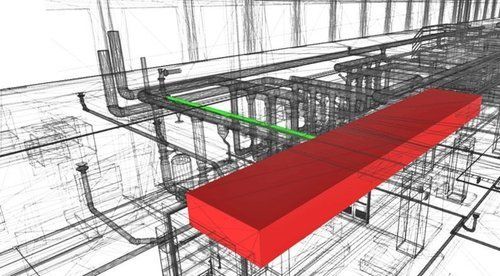
Detect direct geometric conflicts where modeled components occupy the same physical space, such as a duct intersecting a structural beam.
02 / Clearance Review
Soft & Access Clashes
Review required separation, access, maintenance or installation zones around equipment and building services.
03 / Coordination Review
Spatial Interface Issues
Review model interfaces that may not be direct collisions but still create routing, constructability or access concerns requiring project-team consideration.
Multidisciplinary Coordination
Common Model Interfaces We Review
Clash tests can be grouped by discipline and project zone so teams can focus on coordination interfaces that matter.
Service routes against primary and secondary structural elements.
Ducts through beams, pipework through slabs, containment crossing framing.
Coordination between mechanical, electrical and plumbing/public health services.
Ductwork, pipework, containment and equipment competing for the same service zone.
Building services against walls, ceilings, partitions and architectural features.
Ceiling void congestion, services through partitions and equipment access constraints.
Structural systems checked against spatial and architectural requirements.
Columns within openings, framing conflicts and structural elements affecting architectural space.
Coordination Before Construction
Review Model Interfaces While They Can Still Be Changed
Coordination is most useful when issues are identified early enough for the responsible project disciplines to review alternatives and update their information.
Federated model review provides a shared spatial context for discussing openings, service routes, structural interfaces, plant access and congested areas before those issues become installation problems.
Coordination Capabilities
What Our Clash Detection Services Can Include
Coordination scope can be configured around individual model reviews or repeated issue-management cycles.
01
Model Federation
Discipline models brought together into a coordinated review environment using agreed model versions.
02
Clash Test Configuration
Relevant model groups, exclusions and tolerances defined around the coordination requirement.
03
Hard & Clearance Tests
Physical intersections and agreed spatial clearance requirements reviewed separately.
04
Clash Triage
Results reviewed to reduce duplicate or low-value clashes before issues are communicated to the project team.
05
Issue Reporting
Coordination issues organised with model context, locations and supporting information where required.
06
Re-Test After Updates
Revised models can be federated again to review outstanding, changed and resolved coordination issues.
Project Information
Clash Detection Inputs and Deliverables
Effective coordination depends on clearly identified model versions, responsibilities and agreed clash-test requirements.
Typical Inputs
- Architectural BIM models
- Structural BIM models
- MEP BIM models
- Revit or agreed exchange files
- IFC models where applicable
- Coordination zones and priorities
- Agreed tolerances or clearance requirements
- BIM Execution Plan requirements
Typical Deliverables
- Federated coordination model
- Configured clash-test sets
- Clash and coordination issue reports
- Model viewpoints and screenshots
- Issue status information
- Discipline or zone-based issue grouping
- Updated review results after model revisions
- Coordination summaries where included
Coordination Workflow
How a Clash Detection Cycle Works
01
Receive Models
Confirm current discipline files and model revisions.
02
Federate
Combine models into the agreed coordination environment.
03
Run Tests
Execute relevant clash and clearance checks.
04
Triage
Review results and organise meaningful coordination issues.
05
Report
Communicate issues for responsible teams to review.
06
Re-Test
Review revised models and track remaining issues.
Issue Management
A Clash List Is Only Useful When the Issues Are Manageable
Raw clash-test results can contain duplicates, repeated geometry and low-priority intersections. Coordination therefore needs issue organisation as well as software testing.
Group
Related clashes can be organised by location, discipline or coordination zone.
Prioritise
Important interfaces can be separated from low-value or accepted conditions.
Assign Context
Issues can include viewpoints, model references and enough context for project-team review.
Track
Subsequent model revisions can be reviewed against outstanding coordination items.
Coordination Technology
BIM Tools and Model Information
Clash detection works best when the coordination environment receives consistent model versions and clearly defined discipline information.
Tools support the review process, but meaningful coordination still depends on suitable test rules, issue triage and project-team decisions.
Navisworks
Federated model review and configured clash testing across multidisciplinary project information.
Autodesk Revit
Discipline models can be reviewed and subsequently updated by the responsible authoring teams.
IFC
Open-model exchange can support coordination where project disciplines work across different platforms.
Federated Models
Multiple discipline models combined without replacing ownership of the original source models.
Model Viewpoints
Visual context can help project teams understand where an issue occurs and which systems are involved.
Revision Tracking
Current model revisions should be clearly identified before each coordination cycle is run.
UK BIM Requirements
Coordination Within a Controlled Information Workflow
Clash detection is most effective when model versions, responsibilities and issue-management processes are clearly defined within the project’s BIM workflow.
Delivery can align with ISO 19650 information-management principles, agreed BIM Execution Plans and project-specific coordination requirements.
Coordination Can Be Defined Around
- Approved model revisions
- Discipline responsibilities
- Agreed clash-test matrices
- Clearance and tolerance requirements
- Model zones and coordination priorities
- Issue status and review cycles
- BIM Execution Plan requirements
Clash Detection Identifies Issues — It Does Not Automatically Resolve Design Responsibility
A clash-detection model highlights modeled conflicts and coordination risks based on the supplied project information and configured tests. Decisions about redesign, routing, engineering approval and acceptance of individual issues remain with the responsible project disciplines unless model revision services are explicitly included in the agreed scope.
Project Evidence
See BIM Coordination in Practice
Review a project example showing how BIM coordination and clash-detection workflows were used on a real construction project.
Related BIM Services
Build the Coordination Workflow Around the Required Models
3D BIM Modeling
Develop discipline models for coordinated project review.
3D BIM Modeling →Structural BIM Modeling
Structural BIM information for multidisciplinary coordination.
Structural BIM →MEP BIM Modeling
Building-services models for routing, spatial review and coordination.
MEP BIM →Common Questions
BIM Clash Detection FAQs
What models are needed for BIM clash detection?
Clash detection normally requires two or more discipline models that need to be coordinated, such as architectural, structural and MEP models. The specific model packages depend on the project coordination scope.
What is the difference between a hard clash and a soft clash?
A hard clash is a direct physical intersection between modeled elements. A soft or clearance clash concerns an agreed space around an element, such as access, maintenance or installation clearance.
Can you coordinate architectural, structural and MEP models together?
Yes. Those discipline models can be federated and reviewed together where they form part of the agreed coordination scope.
Do you provide clash reports?
Clash and coordination issue reporting can be included in the agreed deliverables, with issues grouped and presented with relevant model context.
Does clash detection mean the BIM model will be completely clash-free?
No clash-detection process should be treated as an absolute guarantee that every construction issue has been eliminated. Results depend on the supplied model content, test configuration, tolerances, project stage and subsequent design changes.
Can revised models be checked again after issues are addressed?
Yes. Updated discipline models can be federated and retested to review whether previously reported coordination issues remain, have changed or have been resolved.
Start Your BIM Coordination Review
Need Your BIM Models Checked for Coordination Issues?
Send us your architectural, structural and MEP models, BIM requirements and coordination priorities and we can review the appropriate clash-detection scope.
Request a BIM Quote